
Best Forklift Training Programs (2026)
The leading forklift training programs cover OSHA-aligned instruction and certification. This guide compares the top providers by what each is best for, then covers immersive VR forklift simulation for the spatial practice that online courses cannot deliver.
QUICK ANSWER
The best forklift training programs in 2026 are the National Safety Council and OSHA Education Center for standards-based, OSHA-aligned content, and ClickSafety, 360training, and CertifyMe for fast, low-cost online certification. These cover the classroom and written components. For the real-time spatial judgment a video cannot teach, immersive VR forklift simulation (such as a custom simulator from The Prime VR) lets operators practice maneuvering, pedestrian awareness, and near-miss response safely, alongside the required course and final evaluation.
The programs, and what each is best for
National Safety Council (NSC)
Best for: Standards-based powered-industrial-truck training
A trusted authority for forklift and PIT safety content, widely used for foundational instruction and train-the-trainer programs.
OSHA Education Center
Best for: Online OSHA-aligned forklift certification
Convenient online courses aligned to OSHA 1910.178, suited to distributed operators who need documented classroom and evaluation components.
ClickSafety
Best for: Interactive online safety courses
Interactive OSHA and forklift courses with 24/7 access, a fit for warehouse schedules and multi-shift crews.
360training
Best for: High volume at low cost
Large course catalog with bulk pricing, appealing to big employers certifying many operators on standard topics.
CertifyMe
Best for: Fast online operator certification
Streamlined online forklift certification for employers that need quick, documented compliance for the knowledge component.
SPECIAL MENTION: IMMERSIVE TECHNOLOGY
The Prime VR, for VR forklift simulation
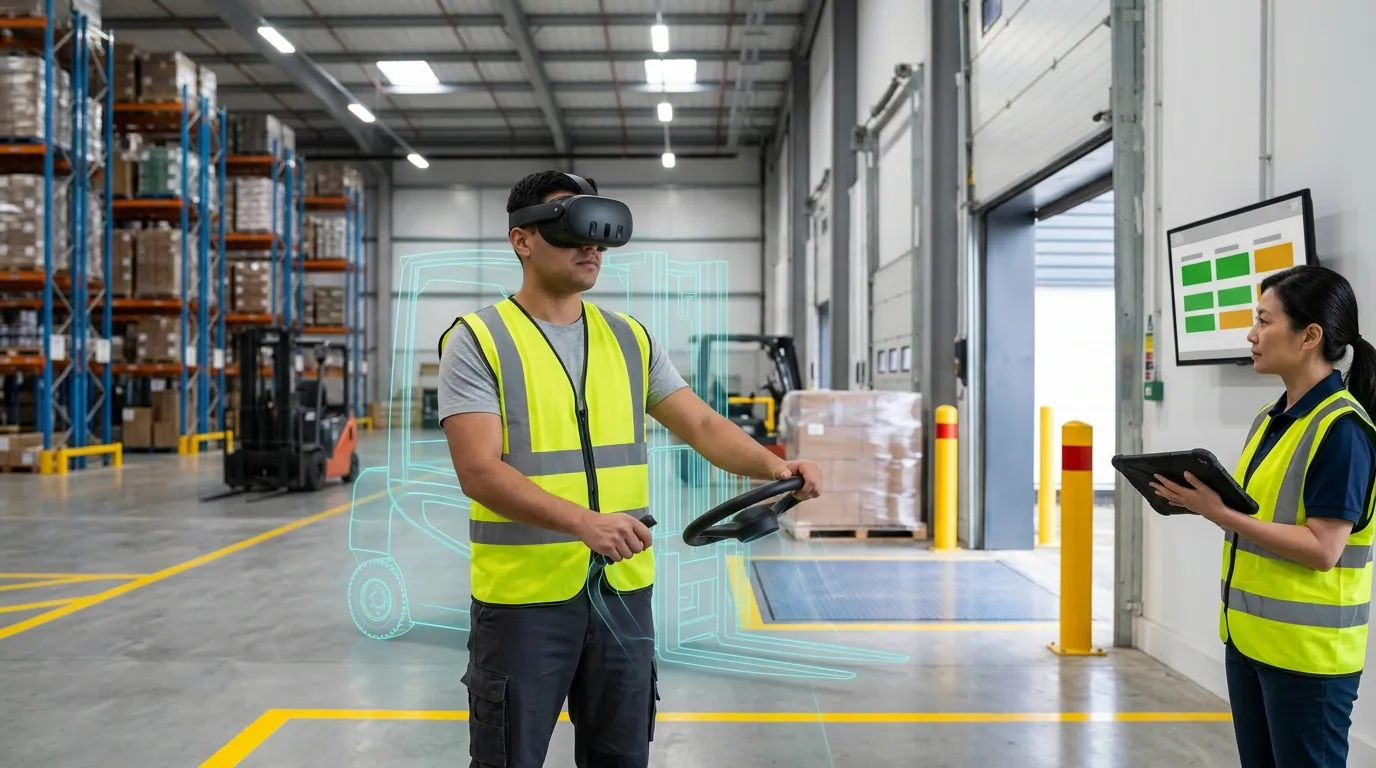
The programs above handle the knowledge and compliance components. The Prime VR represents the immersive frontier: a custom VR forklift simulator built on your real warehouse layout, where operators practice the exact spatial decisions that cause real incidents, tip-overs, blind-aisle pedestrian conflict, high-rack placement, with a simulated consequence instead of a real one. It strengthens the practical-training and evaluation components and pairs with the required final check on a real truck.
See our breakdown of the forklift training simulator and VR safety and operations training.
OSHA Elements to Confirm
Programs must include formal instruction, practical training and an operator evaluation. Ask how each is delivered.
Verify the evaluator's qualifications.
Equipment Specific Training
Different truck types need different skills. Ask whether training covers your equipment and environment.
Include site hazards.
Refresher and Recertification
Evaluation is required at least every three years and after incidents or changes. Plan refreshers.
Keep records for each operator.
What the Requirement Is
Powered industrial truck operation is a regulated activity, and employers are generally required to ensure operators are trained, evaluated and authorized before operating.
The obligation sits with the employer rather than with the operator, which means a certificate carried from a previous job does not by itself satisfy it.
Understanding that structure changes what buyers should look for, since the deliverable is a defensible authorization process rather than a card.
Three Parts to the Training
Requirements generally combine formal instruction, practical training on the equipment and an evaluation of the operator performing the work in the actual workplace.
Online only programs can address the formal instruction component but cannot deliver the practical and evaluation components, and programs implying otherwise should be treated carefully.
The evaluation element is the one employers most often leave incomplete, and it is the element an inspector will ask about.
Equipment and Environment Specificity
Training has to cover the classes of truck the operator will actually use, since a counterbalance truck, a reach truck and a rough terrain machine handle differently.
Workplace conditions including surface, aisle width, ramps, dock work, pedestrian traffic and load types affect what the operator must be trained on.
Attachments change stability and capacity, and operating with an attachment the operator was not trained on is a common and serious gap.
Refreshers and Triggers
Re evaluation is generally required periodically, and refresher training is triggered by an incident, a near miss, an observed unsafe practice, a change of equipment or a change in workplace conditions.
Tracking those triggers requires a process rather than a calendar, and it is where most programs fall short administratively.
An operator involved in an incident who continues without refresher training is a finding waiting to happen.
Choosing Between Options
Providers include training companies delivering on site, equipment dealers, safety consultants and train the trainer programs that build internal capability.
Train the trainer suits organizations with ongoing hiring volume, while on site delivery suits smaller or intermittent needs.
Whichever route is chosen, the employer retains the obligation, so the internal records and evaluation process matter more than the provider brand.
Questions Worth Asking
Useful questions include which truck classes and attachments are covered, whether practical training and evaluation are included, what documentation is provided and what the employer must do to complete the authorization.
Simulation and structured practice let operators build hazard awareness and handling familiarity before operating equipment in a live workplace.
Applicable safety regulations set the requirements and they differ by jurisdiction, and current obligations should be confirmed with the relevant authority.
Common Mistakes and How to Avoid Them
Common errors include accepting a certificate from a previous employer as sufficient, relying on online only delivery, omitting the workplace evaluation, failing to cover the specific truck classes and attachments in use and not triggering refresher training after an incident.
Supervisors can help by making it acceptable to pause and ask. A culture where questions are treated as competence rather than weakness produces fewer errors in forklift operator training.
How Employers Evaluate Readiness
Employers assess this through incident and near miss records involving powered trucks, damage to racking, product and equipment, observed operating practice, inspection findings and whether authorization records are complete.
Keeping Skills Current
Equipment, attachments, workplace layouts and regulations change. Re evaluating operators after a change in conditions or equipment prevents authorizing someone for work that no longer matches what they were trained on.
Planning and Preparation
Preparation includes identifying every truck class and attachment in use, documenting workplace conditions the training must cover, confirming who will perform the practical evaluation and establishing the trigger list for refresher training.
Documentation That Holds Up
Operator authorization records naming the equipment covered, formal instruction and practical training records, dated evaluation records with the evaluator identified and refresher records tied to triggers are what an inspection examines first.
Frequently Asked Questions
What is the best forklift training program?+
It depends on what you need. The National Safety Council and OSHA Education Center are strong for standards-based, OSHA-aligned content and documentation, while ClickSafety, 360training, and CertifyMe lead for fast, low-cost online certification of the knowledge component. All of these cover the classroom and written parts well. The part they cannot deliver is realistic spatial practice, which is exactly where immersive VR forklift simulation fits, covered below. Most strong programs pair an online or classroom course with hands-on practice and a final evaluation on a real truck.
Does forklift training have to be in person?+
OSHA 1910.178 requires formal instruction, practical training, and an evaluation. The formal-instruction part can be online, but the practical and evaluation parts must demonstrate the operator can actually perform. Many employers use online or classroom courses for the knowledge component and add hands-on or simulator practice plus a final evaluation on a real truck. A VR simulator strengthens the practical component because operators perform the spatial tasks and the system logs how they do.
How does VR forklift training compare to online courses?+
Online forklift courses are efficient for the knowledge and compliance component, but forklift safety is real-time spatial judgment that a video cannot teach. VR forklift simulation lets operators practice maneuvering, load handling, pedestrian awareness, and near-miss response inside a replica of the warehouse, with a simulated consequence for error instead of a real one. It complements the required course and final evaluation rather than replacing them.
How often is forklift evaluation required?+
At least once every three years under OSHA rules, and sooner after certain incidents.
Can forklift certification be online only?+
No, a practical evaluation on site is required in addition to instruction.
Train forklift judgment, not just the test
We build a custom VR forklift simulator on your real facility and top incident types. Tell us your layout and we will scope it.